
Table of Contents:
- What “skill building” really means in data science
- Free data science courses: what they do well
- The hidden problems with free learning
- No clear learning path
- No accountability
- No feedback loop
- Weak or no projects
- Paid data science courses: what they do differently
- Structured curriculum
- Higher completion rates
- Real projects with expectations
- Feedback and mentoring
- Career alignment
- Cost vs value: the real question
- When free learning is still useful
- What to check before paying for a course
- Why structure matters more in data science than other fields
- Time efficiency is underrated
- No course replaces effort
- Final takeaway
- FAQs
People often ask a simple question: should I learn data science for free or pay for a course? The internet makes free learning easy. Videos, blogs, and notebooks are everywhere. At the same time, paid courses promise structure, projects, and job readiness.
Both options teach something. But if the goal is real skill building, paid courses usually work better. Not because they are fancy. But because they are planned, guided, and consistent.
Let’s break this down in a practical way.
What “skill building” really means in data science
Skill building is not watching videos. It is not finishing a playlist. It means you can:
- Clean messy data
- Write Python or SQL without copying
- Build a model and explain why you chose it
- Interpret results in simple language
- Handle errors without panic
These skills come from practice, feedback, and repetition. And this is where free and paid paths start to differ.
Free data science courses: what they do well
Free courses are not useless. In fact, they are often the first step.
They are good for:
- Understanding what data science is
- Learning basic Python syntax
- Exploring tools like Pandas or Excel
- Deciding if this field interests you
Many people discover data science through free content. That is a good thing.
But free learning usually has gaps.
The hidden problems with free learning
Free courses often look complete on the surface. But when you follow them closely, problems appear.
1. No clear learning path
Most free content is topic-based, not skill-based. One video explains Python lists. Another explains linear regression. But there is no bridge between them.
You are left wondering what to learn next.
2. No accountability
When learning is free, stopping is easy. There are no deadlines. No reviews. No one checks your work.
Course platform data shows that free learners drop out far more often than paid learners. Paid learners complete courses at almost 2x the rate, mainly due to accountability and structure.
3. No feedback loop
You may complete a project. But who reviews it? Who tells you if your approach is wrong or inefficient?
In data science, silent mistakes are dangerous. You may think you learned something, but actually picked up bad habits.
4. Weak or no projects
Many free courses avoid full projects. Or they give guided notebooks where answers are already there.
That does not build confidence. And it does not impress employers.
Paid data science courses: what they do differently
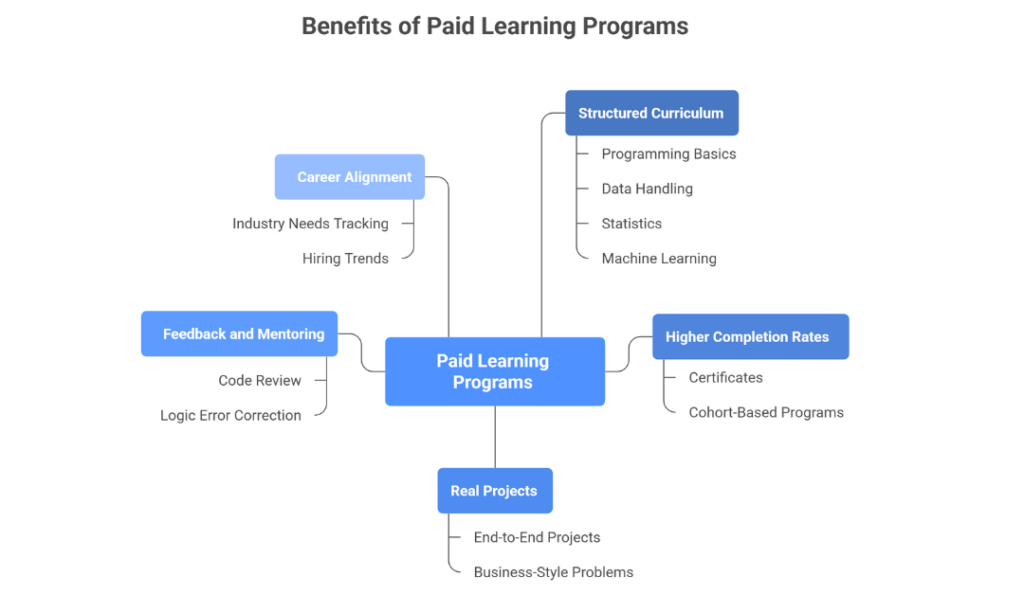
Paid courses are not perfect. But good ones solve many of the problems above.
Structured curriculum
Paid programs are designed backward. They start from job requirements and build skills step by step.
You don’t jump randomly from topic to topic. You move in order:
- Programming basics
- Data handling
- Statistics
- Machine learning
- Real projects
This structure reduces confusion and saves time.
Higher completion rates
Learner outcome reports from major platforms show that paid learners complete courses at significantly higher rates than free learners. Certificates and cohort-based programs further improve completion and consistency (source: Coursera and ed-tech learner outcome studies).
This matters because unfinished learning does not build skills.
Real projects with expectations
Paid courses usually require:
- End-to-end projects
- Business-style problem statements
- Clear evaluation criteria
You are expected to think, not just follow steps.
These projects become portfolio pieces. Recruiters care about this more than certificates.
Feedback and mentoring
This is one of the biggest differences.
In structured paid programs:
- Mentors review your code
- Instructors correct logic errors
- You learn how professionals think
This shortens the learning curve. It also builds confidence.
Career alignment
Many paid programs track industry needs. They update content based on hiring trends.
Employment projections show strong long-term growth for data-related roles, including data scientists and analysts, with double-digit growth expected over the decade. Paid programs align skills to these roles, not just theory.
Cost vs value: the real question
People focus too much on cost. The better question is value.
A free course that you abandon halfway has zero value.
A paid course that helps you build a portfolio and land interviews has high value.
Some paid learners report:
- New job roles
- Salary increases
- Career switches within a year of completion
These outcomes are commonly reported in post-course learner surveys from major online platforms.
This does not mean payment guarantees success. But it increases the odds.
When free learning is still useful
Free learning still has a place.
Use free resources when:
- You want a quick overview
- You are testing interest
- You need revision on one topic
- You want to supplement a paid course
Free + paid together works better than free alone.
What to check before paying for a course
Not every paid course is good. Be careful.
Check for:
- Clear syllabus
- Minimum 3–5 real projects
- Mentor or instructor access
- Code reviews or feedback
- Career support or guidance
If a course only sells certificates, be cautious.
For learners who prefer in-person guidance and local hiring exposure, Inventateq’s programs like a Data Scientist Course in Bangalore can help through peer learning and networking. Those who need flexibility may choose a structured Data Science Training Online option that still includes mentorship and projects.
Why structure matters more in data science than other fields
Data science combines multiple skills:
- Programming
- Math
- Logic
- Business understanding
Without structure, learners often over-learn one part and ignore others. Many beginners know Python syntax but cannot explain a model. Others know theory but cannot write code.
Paid programs balance this better.
Time efficiency is underrated
Free learning often feels cheap. But it costs time.
Many learners spend:
- Months jumping between videos
- Weeks stuck on basic errors
- Long breaks due to confusion
Structured paid programs reduce wasted time. They guide focus. This matters if you want results within months, not years.
No course replaces effort
This needs to be said clearly.
A paid course will not:
- Think for you
- Practice for you
- Apply for jobs for you
You still need discipline. You still need practice. Paid courses simply remove guesswork and give direction.
Final takeaway
Free data science courses are useful at the start. They help you explore and understand the basics.
But for serious skill building, paid courses usually work better. They provide structure, accountability, feedback, and job-aligned learning. These factors matter more than price.
If your goal is to become employable, not just informed, a well-designed paid program is often the smarter path.
FAQs
1. Is a paid data science course better than free ones?
Yes, for skill building and job readiness. Paid courses offer structure, feedback, and projects.
2. Can I get a data science job using only free courses?
It is possible but difficult. Most successful learners combine free learning with structured paid training.
3. Why do paid learners complete courses more often?
Because of deadlines, accountability, and financial commitment, which increase consistency.
4. How many projects should a data science learner have?
At least three strong, end-to-end projects that show problem-solving skills.
5. Do employers care about certificates?
They care more about projects and practical skills. Certificates help only when backed by work.
6. How long does it take to become job-ready?
With structured learning and regular practice, many learners reach job readiness in 6–9 months.
7. Is mentorship important in data science learning?
Yes. Feedback prevents mistakes and speeds up learning.
8. Should beginners start with free or paid courses?
Start free to explore. Move to paid when you decide to commit seriously.