
Table of Contents:
- Why campus placements are not enough anymore
- Why data science makes sense for fresh graduates
- The real problem with most online courses
- How Inventateq focuses on job readiness
- What being “job-ready” actually means
- A realistic learning path for students
- Why this approach works better than campus drives
- Common mistakes students should avoid
- What you should check before enrolling anywhere
- Final thoughts
- FAQs
Campus placements don’t feel reliable anymore. Many students finish their degree, sit through placement drives, and walk away disappointed. Fewer companies visit campuses. Even when they do, they hire in small numbers. Some roles are low-paying or unrelated to what students studied.
If you are in that situation, you’re not alone. And no, it doesn’t mean you failed. It means the system has changed.
One practical way forward is learning data science with real-world focus. Not theory-heavy lessons. Not abstract models. But skills that companies actually use. That’s where Inventateq fits in.
This blog explains why campus placements struggle, how data science helps, and how Inventateq prepares you for real jobs instead of false promises.
Why campus placements are not enough anymore
Colleges still teach the basics. Degrees still matter. But hiring has moved faster than academic updates.
Most placement training focuses on:
- Aptitude tests
- Basic coding questions
- General interviews
But companies today want people who can:
- Work with real data
- Solve messy problems
- Explain insights to non-technical teams
Because of this gap, placement numbers have dipped in many colleges. A few students get placed. Many don’t. Even among placed students, several roles offer low growth.
At the same time, the demand for data professionals keeps rising. NASSCOM estimates that India will need close to 1 million AI and data professionals by 2026. That gap creates opportunity for students who upskill early.
Why data science makes sense for fresh graduates
Data science is not limited to coding experts. It involves:
- Understanding data
- Asking the right questions
- Finding patterns
- Explaining results clearly
Companies need this skill across industries. Finance, healthcare, retail, logistics, marketing — all use data.
Bangalore remains a strong market for these roles. Job platforms regularly show thousands of openings for data analysts and data scientists in the city.
Pay is another factor. The median salary for a data scientist in Bangalore is around ₹13.5 LPA, though it varies by skill and experience.
So even if campus placements fall short, data science opens a second door.
The real problem with most online courses
Many students try online courses first. Some help. Many don’t.
Common issues:
- Too much theory
- No real projects
- No feedback
- No interview preparation
Students finish the course but still can’t explain what they built. Recruiters notice this quickly.
Learning data science only works when you practice it the way companies use it.
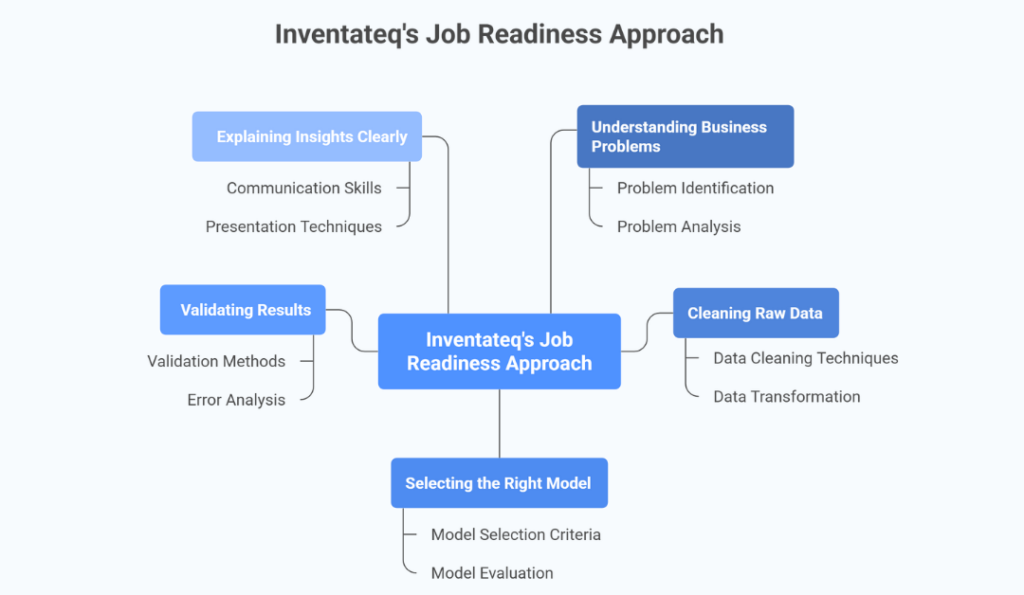
How Inventateq focuses on job readiness
Inventateq’s approach is practical. It is built around how real teams work.
You don’t just learn tools. You learn the full process:
- Understanding a business problem
- Cleaning raw data
- Selecting the right model
- Validating results
- Explaining insights clearly
This matters because most interview questions revolve around how you think, not just what library you used.
Students also work on industry-style projects. These are not textbook examples. They involve real datasets and real constraints.
Inventateq also offers placement support. This includes:
- Resume reviews
- Mock interviews
- Project explanations
- Career guidance
That support matters when campus placements fail to deliver.
For learners looking for local access, Inventateq also offers options like Data Science Training in Rajajinagar and Data Science Training in Kalyan Nagar, making it easier to attend sessions and get in-person help.
What being “job-ready” actually means
Being job-ready does not mean knowing everything.
It means:
- You can explain your projects clearly
- You understand why you used a method
- You can talk about mistakes and improvements
- You can connect data insights to business outcomes
Hiring managers value clarity more than perfection.
Inventateq trains students to speak about their work in simple language. That’s what interviews test.
A realistic learning path for students
Here’s a practical way to approach data science learning:
Step 1: Build strong basics
Learn Python, SQL, statistics, and data visualization. Don’t rush. Focus on understanding.
Step 2: Work on real projects
At least three projects:
- One data cleaning and analysis project
- One predictive or classification model
- One project with dashboards or deployment
Step 3: Create a clean portfolio
Put your code on GitHub. Write short project summaries. Show results, not buzzwords.
Step 4: Practice interviews
Explain your choices. Talk through your logic. Keep answers simple.
This structure matches what companies expect from entry-level data roles.
Why this approach works better than campus drives
Campus placements depend on:
- College reputation
- Batch size
- Market timing
Skill-based hiring depends on:
- Your projects
- Your thinking
- Your communication
Hiring data shows steady growth in data roles, even when general hiring slows. One hiring report showed around a 15% increase in traditional data science roles year-over-year.
This means skilled candidates still find opportunities, even outside campus drives.
Common mistakes students should avoid
- Memorizing code without understanding it
- Using copied projects
- Focusing only on accuracy numbers
- Ignoring data cleaning steps
- Overcomplicating explanations
Recruiters prefer honest answers over flashy terms.
What you should check before enrolling anywhere
Before choosing any data science program, ask:
- Are projects realistic?
- Is there interview preparation?
- Do mentors have industry experience?
- Is placement support practical or generic?
If these are missing, results will be limited.
Final thoughts
Poor campus placements can feel discouraging. But they don’t define your future.
Data science offers a practical path forward when learned the right way. Inventateq focuses on skills, projects, and job readiness, not promises.
It takes effort. It takes discipline. But it gives you control over your career instead of waiting for a placement list.
And that difference matters.
FAQs
Q1. Can fresh graduates learn data science without experience?
Yes. Many entry-level roles focus on projects and skills, not past jobs.
Q2. How long does it take to become job-ready?
Most students take 3 to 6 months with consistent practice.
Q3. Do I need strong math skills?
Basic statistics is enough to start. You improve as you practice.
Q4. Are data science jobs only in Bangalore?
No. Bangalore has more openings, but remote roles are growing.
Q5. Will this guarantee a job?
No course can guarantee a job. But strong projects and preparation improve your chances.
Q6. What salary can freshers expect?
Entry-level salaries vary. Median data scientist pay in Bangalore is around ₹13.5 LPA, depending on role and skills.
Q7. Is a data science course better than waiting for campus placements?
For many students, yes. It creates opportunities beyond campus limits.